Four Miniatures: Natural Complexity;
Road of Change; Loss of Rhythm;
Musica Sacra
Four Miniatures: Natural Complexity;
Road of Change; Loss of Rhythm;
Musica Sacra
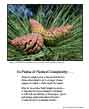
(1) In Praise of Natural Complexity
From the single trunk, a thousand branches;
From a thousand rivulets, a single stream.
Simple to complex; And complex to simple.
Why do we not see that Complicatedness—
or that which is unnecessarily convoluted
or difficult—is a failure of human perception
and design, and not an inherent feature
of either natural or cultural worlds?
| Picture/Poem Poster
In Praise of Natural
Complexity
shown at the right
(prints 81/2 x 11" (A4))
Also available as .pdf
download (74 K) |
(2) Road of ChangeDown the rough road of change, a wheel keeps
its true by centering in the clear intentions
of the motionless hub.
(3) On the Loss of Rhythm
The body of Western culture is but half
a body, divided or cut off at the waist, centered
not in the heart or navel, but in the eyes.
Sitting at the controls is this halfbody's activity of choice.
In front of the TV, the computer, or steering
wheel of a car.
But what of the poor feet?; they might tell us
that one cannot think clearly about much of anything,
—especially dance, or music, or poetry—without
living by, and with, the slow steady cadence of walking.
(Witness the automobile: so utterly
without rhythm, it simply wishes to
continue without interruption
on its smooth, mechanical trajectory...)
And so, our sense of rhythm of both things
small and large is falling by the wayside,
atrophying like an organ no longer used.
And so, we get bored. Bored for
lack of rhythm. Indeed, boredom, it might be said,
has become a key feature of this culture of the halfbody,
a boredom which we seek to escape by more sitting
in front of the controls.*
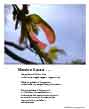
(4) Musica Sacra . . .
The goddess of Selfless Love
resides in the winged elegance of grace notes;
While the goddess of Compassion
resides in the airy weight of the perfect unison;
But only the goddess of Mystery
and the Unknown—the nameless one—
resides in the dark spaces between the stars
we so wish to connect, the silences that
come just before, after,—
and in between.
| Picture/Poem Poster
Musica Sacra
shown at the right
(prints 81/2 x 11" (A4))
Also available as .pdf
download (64 K) |
| download / view all four Posters as a set: 2 Miniatures: Musica Sacra [140 K] |
|
P/P Miniature Posters: Octet One PDF (952 K) |