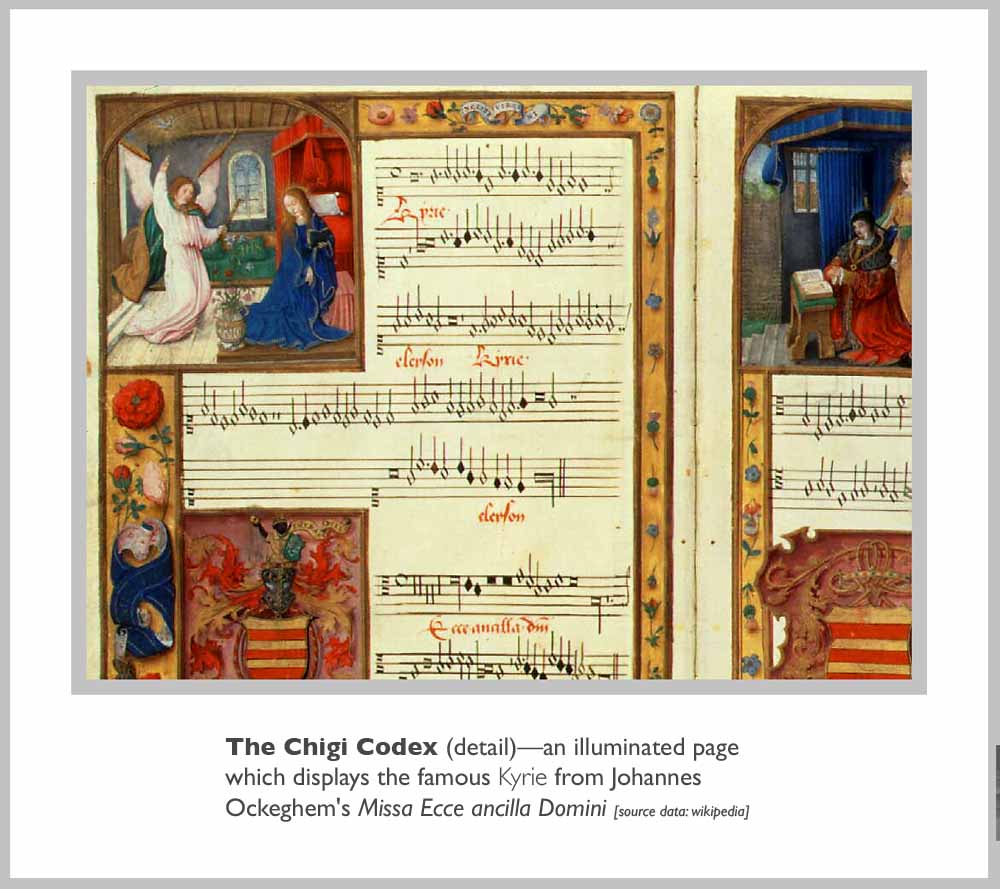
The magnificent Chigi Codex (detail) . . .
On the road in the American Northwest. [click photo for next . . . ]
The magnificent Chigi Codex (detail) . . .
On the road in the American Northwest. [click photo for next . . . ]
THE Chigi CODEX
"Music? The one thing humans do
that makes the rest of Nature jealous."
A key assumption of the present largely tacit cultural metaphysics is that, new is better.
This is easy to believe as long as we remain isolated from the negative side-effects of, say, the digital technology revolution. Given all the happy talk on the diversity of the long tail of digital commerce, it is hard not to be swept up in one big glorious wave of excitement and energy. Without wanting to pull the plug on the party lights, I would only say that it is important to regularly pause, step back, and consider things from a wider or more philosophical perspective.
In this spirit, consider for a moment the above beautifully illuminated manuscript--from the Latin manus, or "that which can be held in the hand." The manuscript is about 500 years old. So in Bach's time, it would have already seemed like an artifact of the distant past. I think we need to remember that this was a time when Aristotle's idea from the POLITICS, that charging interest on loaned money is unethical, was still considered true. "Money parenting money," as he memorably put it. As I've written elsewhere, I agree. [see below]
The Chigi Codex era of 500 years ago is also a time when Music--literally, "that which is received from, or given to us by the Muses"--still stood at the very center of culture. Hamonia mundi. Harmony of the spheres. Nada Brahma, or the world is sound. For me, this is still very much the case. This is how I experience not just music, but more generally the generative movements of the natural world around me. So, if conservation is about dealing in a measured way with the fundamental asymmetry of both Nature and Culture--that creation is slow, and destruction fast--then we might do well to be mindful of what is being lost in creative traditions around the planet. Like languages. Like the traditional knowledge of the healing plants. Or like the vibrantly alive sense of real, living, acoustic sound, and not merely mechanical noise and other 2nd-hand synthetic artifacts like synthesizers, electric guitars, or drum computers with which we in Western culture have surrounded ourselves. My view here is very simple: Music, like peace, like love, like meditation, is its own end, its own reward. Music is in this view not a commodity, although, like Eros and sexual passion, we can easily make it one.
SEE ALSO my essays:
(1) WHEN GROWTH IS 'FALSE COMPARE'
(2) OUT OF CONTROL—the runaway economies
of systemic imbalance
MUSIC AS COMMODITY
Once we have divided the world into the separate conceptual frames of
living subject and lifeless object, it is but a single easy step from lifeless
object to resource, and from resource to commodity.
This habit of the mechanical brain of mapping life onto the lifeless has
conditioned historically how we see and act towards rivers, towards
forests, and soil and the land generally. So it should come as no surprise
that we now follow the same pattern or habit of thought when it comes
to Culture as well.
Consider music. Music in high-tech Western culture is no longer something
that we make or play; Music has been reduced to a mere object or
commodity we must have or buy. Music has become life-style. What
does the Pope, or the President have on their iPod? Good god, smash
the damn thing! And to think that just two hundred years ago, Thomas
Jefferson is said to have practiced violin for two hours a day. Or it was
perhaps a French translator’s lively fiddle playing that got Lewis and
Clark and the great Corps of Discovery safely across a vast, wild
continent and back.
So what have we lost in the wake of our technical sophistication? I
would say it is the life, or the spirit of the sound. The sound of real
plucked and bowed strings. The sound of a real trumpet across a quiet
forest lake. The sound of the living, talking drum. That’s what we’ve
lost.
WASTE OF TALENT
We shape the world and the world shapes us.
See the empty glamour of the contemporary music virtuoso. Technical
sophistication perhaps, but without the joy and passion which come
naturally with the great journey of discovery into the wilds of the unknown.
How many more complete Beethoven cycles do we need? Such a waste
of talent, such great poverty of spirit, of meaning. Like love for sale, the
movements may look exactly the same, but everybody
knows your heart isn’t in it.
THE POET’S LYRE
Between the pegs of Nature,
and Culture,
I span my string.
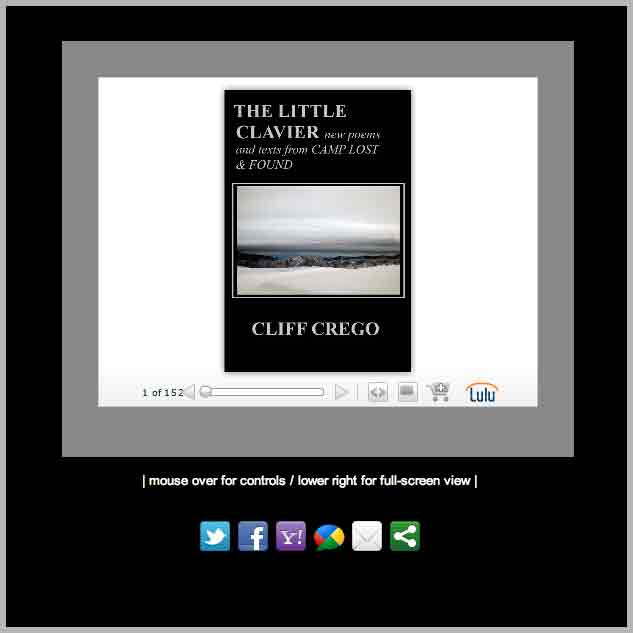
WASTE OF TALENT & THE POET'S LYRE are part
of THE LITTLE CLAVIER please preview 150 of 631 pages
w/ my black & white photography [opens in new window]
Follow @cliffcrego
Featured gallery, mountain water . . . .Please visit my MOUNTAIN WATER Gallery—some of
the best of my flowform photography w/ a selection of the highest quality
prints & frames . . . [ mouse over for controls / lower right fro full-screen ]
All Photographs & texts by Cliff Crego © 2014 picture-poems.com
(created: IV.27.2008)