COMPOSITION IN WHISKEY . . . (special thanks to my good friend, Bert Rogers, [click photo for next . . . ]
for allowing me to make this photo at Annie's Liquor Store, in Eagle Valley, Richland, Oregon.)
On the road in the American Northwest.
COMPOSITION IN WHISKEY . . . (special thanks to my good friend, Bert Rogers, [click photo for next . . . ]
for allowing me to make this photo at Annie's Liquor Store, in Eagle Valley, Richland, Oregon.)
On the road in the American Northwest.
WHISKEY—a long-line sonnet
He could see everything he ever dreamed of
Inside a fresh, new bottle: The young, handsome
Rodeo cowboy, shooting Geronimo on a Hollywood
Set, or taking care of that last ferocious bear above town.He always set out two glasses before breaking
Open a new bottle. One for solitude; Two to spit at.
You can't steal inside heaven in hell; One must buy it,
One bottle, at a time. The price of clear crystal.Inside the bottle he sees a world more real than
The squalor around him. He pours two more glasses,
Puts his boots up on the table, then spins the chamberOne last time. He likes the sound. Well-oiled. He stands,
Kicks the door open, then throws the last bottle into the air,
Shooting it before it smashes to the ground. He always misses.
| listen to / download WHISKEY mp3 [ 2.2 Mb] |
[Windows: r click; Mac: opt + click] |
V.6.2010
Thompson Meadows,
Eagle Cap Wilderness
 |
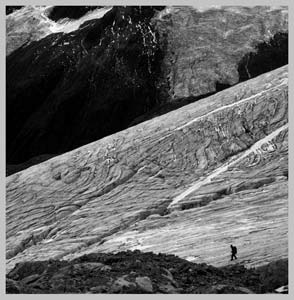 |
WAYFARER— a long-line sonnet |
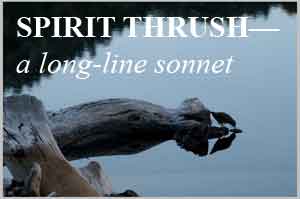 |
LONG-LINE SONNETS are a new variation on an old form: four stanzas of 4 + 4 + 3 + 3 lines, without end-rhymes, and only with a rough step or syllable count--as in a dance--of ± 12 or 14 steps per line or phrase. As always, what is primary for me is the movement of the sound itself, as a kind of music. Very much secondary is how a poem is written down or notated on the page. Indeed, the notation is simply a kind of elementary score, no more and no less, just as if it were intended for flute or voice, or keyboard.The series is unified firstly from within by what I sense as a similar sonorous sound, with the long-line phrases all being based on the breath just as a good singer might do. In addition, there's much attention given to what I think of as related species of resonance. The latter replaces--happily, in my view--the somewhat rigid and outmoded emphasis on the mechanical patterns of similarity we call 'rhyme.'
Second, for me personally, the series is held together by its mostly European cultural theme. In a word, what interests me here is what I sense as a kind of rough-hewn spiritual excellence:--a kind of miraculous clear mountain quartz of the soul just after its opaque gray-green clay is washed off. And this, regardless of where it manifests, whether it be a magnificent cathedral, a defiant old poet on top of an appallingly hubristic dam in the French-speaking Alps, or simply in the care and skill
with which a mountain farmer builds his piles of well-composted cow shit. Indeed, this is what moves me to compose and work on them in the first place:--a kind of Heimweh or homesickness for a part of me that is much more European than North American. Part of that is my past. After all, I've lived in different European countries, especially the lowlands of Holland, and the highcountry of the Alps and Switzerland, the better part of my adult life. But this is not the Europe of tourist buses and famous attractions known to many speakers of English. It is a far lesser travelled, and yet much more vibrantly alive "old country" which exists in its own, indeed ancient, and to my way of thinking, still relevant time-space.In this view, real beauty does not grow old.
The beauty and power of a Bach hymn, or of John Dowland, is in this sense timeless. And there is a part of Bach, for example, a depth of feeling and resonance, that I think we miss entirely in North America. The latter must--and I offer this only as a conjecture--have something to do with the beauty of the German language itself, as well as the organic power of the German highland countryside out of which its sound and rhythms emerged. The English spoken in North America is, to my ear at least, still far too young to have developed anything like this kind of deep relationship between sound, meaning, and a love of the living, pulsing land.
| listen a quartet of sonnets, with interpolations of
some of my music |
| download mp3 | c. 9' 11.6 Mb [Windows: r click; Mac: opt + click] |
Please visit my picture-poems.com MOUNTAIN WATER print gallery Above is a set of recent flowing water images. (Mouseover for TITLES & CONTROLS!)I might just mention here that, following the simple, basic ethical principle, First, do no harm, I never use cars or jeeps or or snowmachines. Instead, I do everything on foot, bike or ski. I think this in a deep and direct way affects my work, and how I see and experience the world generally. So know thaty all the photos collected here were approached on foot -- including all the in between spaces -- sometimes involving journeys of weeks, or even months.
I would not want to work any other way . . .